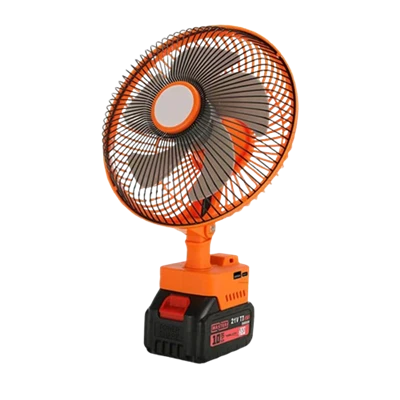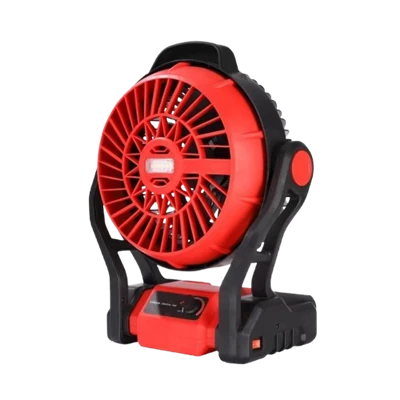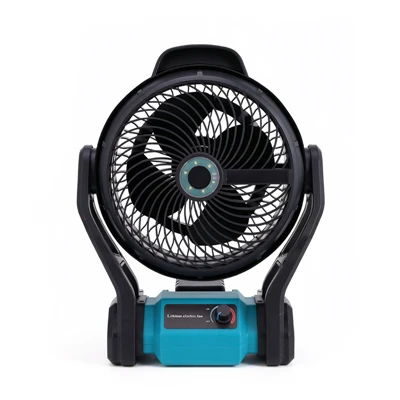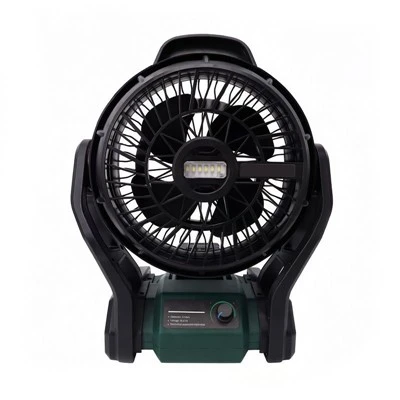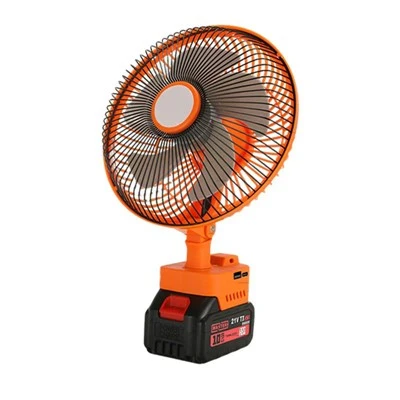

Floor fans typically consist of core components such as a motor, fan blades, a fan guard, an oscillation mechanism, a support and adjustment mechanism, and control and operation sections.
Motor:
The motor is the core power source. Household fans commonly use single-phase capacitor-driven asynchronous motors, while modern products increasingly use brushless DC motors to improve efficiency and reduce noise. Motor quality directly affects performance, noise, and lifespan. The motor core material varies, including pure copper, copper-clad aluminum, and aluminum wire. Pure copper cores have high magnetic permeability, low attenuation, and a long lifespan. Using high-quality lubricating oil inside the motor reduces friction, wear, and operating temperature, ensuring smooth and quiet operation.
Fan Blades:
Fan blades are usually made of materials such as PP through aerodynamic design. Hard plastic blades provide a larger airflow and are less prone to deformation than soft plastic blades. The number of blades affects the wind feel and noise; more blades allow for a finer airflow, resulting in a softer, more stable, and more natural wind, as well as better airflow control and quieter operation at low speeds. Some high-end models employ special designs such as variable cross-section thickness to reduce airflow resistance and increase airflow and delivery distance.
Fan Blades:
Fan Guard: The fan guard primarily serves a protective function, preventing the human body from touching the high-speed rotating fan blades. Safety standards require the fan guard to be designed to be sufficiently dense, ensuring that an adult's fingers cannot reach the leading edge of the fan blades through the guard, which is especially important for families with children. High-quality fan guards use high-hardness materials, feature a double-ring design, have a large number of mesh lines, and are equipped with reinforced mesh clips and straight-through self-locking mesh hoops to enhance pressure resistance, deformation resistance, and installation stability.
Oscillating Mechanism:
The oscillation mechanism is typically driven by a small synchronous motor or stepper motor, causing the fan head to oscillate left and right to expand the airflow range. Common oscillation ranges include 85 degrees, 90 degrees, and 120 degrees, with some high-end products supporting combined up-down and left-right oscillation or even larger angles. In terms of mechanism design, a fully enclosed gearbox helps reduce noise, prevent dust, and extend motor life.
Support and Adjustment Mechanism:
The base and stand provide overall stability. The chassis should be flat and heavy to prevent tipping. Common height adjustment designs include a freely retractable upright pole, allowing users to adjust the fan height as needed. Tilt-adjustable fan heads typically support manual tilt angle adjustment to change the airflow direction, with common adjustment ranges between 15 and 39 degrees. For portability and storage, new models feature an integrated design, are lightweight, and come with a telescopic rod and storage bag for easy movement and space saving.
Control and Operation:
Control methods include mechanical, remote control, touch control, and smart control via a Wi-Fi-connected app. The user interface usually integrates function buttons for power on/off, fan speed/type switching, timer, and oscillation control. Power and Battery Life: Traditionally using a 220V AC plug, newer models feature a USB Type-C interface for power bank connection and a built-in high-capacity battery for wireless operation.